
Look and orient
Start at the façade, note your entrance, then take a short circuit to understand the types of goods before you decide to buy.
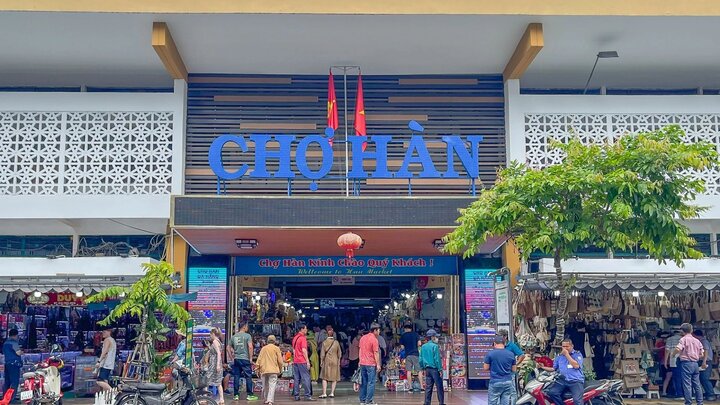
Independent guide · Da Nang
Han Market brings together daily trade, central Vietnamese flavours and colourful aisles a short walk from the Han River.
01 · Context
Public travel references trace Han Market’s beginnings to informal riverside trading in the 1940s. The space grew with central Da Nang and was rebuilt as a two-storey market in the late twentieth century.
Today, it remains a place for everyday shopping as well as a stop for visitors observing local urban life. Treat it as a working community space: move unhurriedly, ask prices clearly, and respect vendors while they serve customers.
09 · Origins & meaning
Han Market took shape in the 1940s around the commercial strip by the Han River, as Da Nang began expanding eastward. For decades the market has been woven into everyday life in Hai Chau: food trading, goods exchange and a meeting point for neighbouring quarters.
By the late twentieth century the market was rebuilt as a solid two-storey structure, keeping its role as one of the city’s central civilian markets. No official legend is recorded, but for locals Han Market is part of the urban memory — the calls of vendors, the scent of central Vietnamese spices and the early lights form a rhythm of their own.
Seeing Han Market as a living community space — rather than a shopping stop — helps visitors approach local culture naturally and respectfully.
02 · Follow the aisles
A good visit does not require a purchase. These three pauses help you experience the market at a comfortable pace.
Start at the façade, note your entrance, then take a short circuit to understand the types of goods before you decide to buy.
Food, dried goods and regional specialities offer a window into central Vietnamese flavours; leave reasonable room around counters in service.
When buying, ask about price, unit, label and packing before agreeing. A calm, polite exchange is part of the market experience.
03 · Inside the market
Layouts and stalls may change. When you arrive, on-site signs and market staff should be treated as the priority reference.
You may find fresh foods, dried goods, seafood, condiments, packaged gifts and food counters. Check labels, use-by information and storage requirements before carrying food onward.
This level commonly includes fabrics, clothing, accessories, household goods and souvenirs. For tailoring or made-to-order items, agree the delivery timing and specifications before committing.
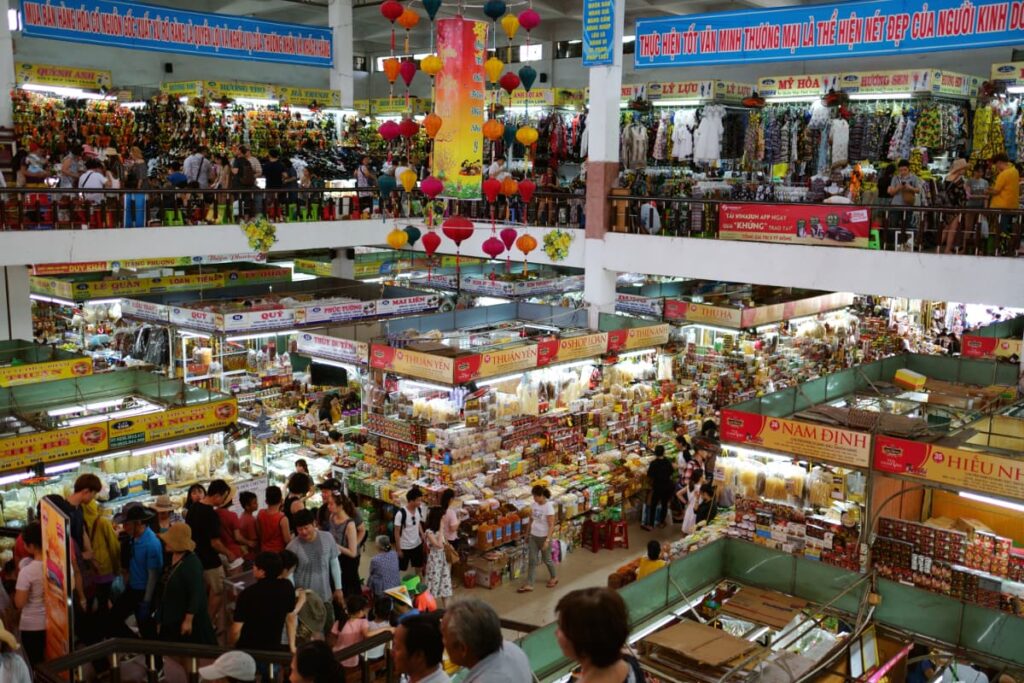
A market is not only a place to buy — it is a cross-section of Da Nang’s urban life.
Illustrative photo: an interior market setting · see copyright note at the foot of this page04 · Practical notes
Facilities and operations can vary. If you need support, ask market staff or the person in charge when you arrive.
Public guides describe no admission charge. Any cost depends on your own choices; ask for the price, unit and a receipt if required.
01Motorbike parking areas may be available on streets around the market. Capacity and charges vary, so confirm the entrance, fee and collection time on site.
02Ask for signs or staff directions to toilets, routes and accessibility support at the time of your visit. Do not assume a fixed location or level of service.
03Market food and drinks may be available. If you have allergies or dietary requirements, ask about ingredients and preparation before choosing.
04Compare before buying, inspect packaging and dates, and only take food onward when you can store it safely during the rest of your journey.
0510 · Facilities & services
The notes below describe common service types around the market and neighbouring centre. We do not rank or recommend any specific operator; choose by need and confirm on site.
Public toilets are usually found in or near the market and on adjacent streets. Location and any fee can vary; ask for signs or the person in charge when you arrive.
Motorbike parking is commonly arranged on streets around the market; some nearby lanes have small car parks. Space and charges shift with peak hours.
The ground floor and nearby pavements have food counters, cafés and drink stalls. For dietary needs or allergies, ask about ingredients and preparation before choosing.
Hai Chau centre concentrates many stay types, from hotels to serviced apartments. Pick by budget, walking distance to the market and access needs.
Convenience stores and minimarts line Tran Phu and side streets, handy for essentials or travel items. Verify opening hours directly.
Fuel stations and EV charging points are scattered across the city centre. Availability changes; use a real-time map to find the nearest active point.
05 · Getting here
A taxi or app-booked ride is a direct option when travelling with luggage. Enter 119 Trần Phú precisely and check the best drop-off point for the local traffic flow.
From central districts and the west bank of the Han River, walking can work in comfortable weather. Taxis and app-based rides are more practical for small groups, luggage or heat and rain.
Urban bus routes, diversions and frequency can change. Use an official public-transport channel or a live journey planner to choose a stop near Trần Phú, Bạch Đằng or Hùng Vương.
From the airport, bus and taxi to the market.
Da Nang International Airport is about 3 km from the market. With luggage, a taxi or app-based ride is the direct choice; drivers usually know Tran Phu. Enter exactly '119 Tran Phu, Hai Chau' and confirm the drop-off before boarding.
Urban bus routes run along Tran Phu, Bach Dang or Hung Vuong. Routes and frequency change; use the public transport operator’s app or a live map to pick the nearest stop, then walk a few minutes into the market.
Traditional taxis and ride apps cover the centre. Agree the fare by meter or in-app estimate before moving, especially at peak times or in rain.
From the west bank of the Han River and the centre, a 10–20 minute walk reaches the market in good weather. Self-drive motorbikes suit those used to local traffic; always wear a helmet and follow the flow.
No fixed route numbers, fares or travel times are stated here because they can change. Check weather, traffic and local notices before leaving.
06 · Location
The map below shows a reference location for Han Market. Near the market, prioritise street signs and follow the local traffic flow.
119 Trần Phú, phường Hải Châu, thành phố Đà Nẵng, Việt Nam
15 · Weather
A reference forecast for the market area, refreshed in real time so you can decide on an umbrella or raincoat.
Bring an umbrella
Updated Sep 22, 14:15
07 · Continue nearby
The following are place types and public settings, not commercial recommendations for any specific business.
The riverside is suitable for a walk, views and continuing a central-city visit after the market.
Nearby streets include religious and historic architecture. Respect opening hours, dress guidance and the everyday use of these places.
You may encounter noodles, cakes, drinks and packaged foods. Assess hygiene, ingredients and your dietary needs rather than relying on advertising.
The city centre includes hotels, guesthouses and serviced apartments. Choose based on budget, access needs and your own itinerary.
Essential retail formats are available in the central area. Verify hours directly instead of assuming every option stays open late.
Fuel and charging availability can change. Use a real-time transport map to find active public facilities or service points.
11 · By season
Da Nang has a dry season (roughly January–July) and a rainy season (roughly August–December, with possible storms in October–November). The table below summarises multi-year climate tendencies to help you pick a time and pack accordingly.
| Season | Months | Climate | Rating | Advice | Pack |
|---|---|---|---|---|---|
| Dry season | Jan–Apr | Fine sun, little rain, cool early mornings | Very favourable | Go early (7–9am) to avoid midday sun | Hat, water, sunscreen |
| Early rainy | May–Jul | Hot, sudden late-afternoon showers | Favourable | Carry a foldable umbrella, go early | Umbrella, light breathable clothes |
| Mid rainy | Aug–Sep | Frequent rain, occasional local flooding | Moderate | Check forecast, avoid heavy-rain hours | Umbrella, non-slip footwear |
| Late rainy & storm | Oct–Dec | Heavy rain, storm risk, rough river waves | Take care | Follow warnings, stay flexible | Umbrella, raincoat, local alerts |
Compiled from multi-year average climate tendencies for Da Nang; actual conditions vary year to year.
12 · Plans by group
Pick a route that fits your companions and mobility so the visit stays relaxed.
Favour the ground floor, visit fruit and snack counters, keep a safe distance from cooking areas. Rest at a seated corner and avoid the busy weekend lunch peak. Bring water and spare essentials.
Slow pace · safeEarly light (7–9am) and late day shape beautiful forms of the market architecture and crowds. Respect vendors when shooting portraits; ask before the lens. Try angles from the façade facing the Han River.
Early light · good framesMove on the flat ground floor, visit counters near the entrance. Avoid peak hours and bring a helper if needed. Ask staff about routes and the nearest toilet.
Ground floor · few stairs13 · Suggested itineraries
Leave the hotel early → Han Market (ground-floor food and dry goods) → try a light bite at a local counter → stroll the Han River and nearby Han River Bridge → return before the harsh midday sun.
Morning: Han Market and architecture photos → midday: central-area dining → afternoon: riverside walk and a nearby heritage building → late afternoon: return to the market for gifts or dry goods → evening: watch the Han River Bridge change colour.
14 · Visiting responsibly
Han Market is a community living space. A few small principles keep the trip safe and preserve local rhythm.
Move slowly, do not block shared walkways, and keep distance from counters in service. Do not handle displayed goods unless buying.
Ask before photographing vendors or customers. Avoid flash in tight spaces.
Ask price, unit and use-by date before agreeing. Keep a receipt if needed, and bargain gently and politely.
Bin waste properly, bring your own bag for dry goods. Choose packaged food if you cannot store it during the trip.
08 · Frequently asked questions
Several public travel references give roughly 06:00–19:00 daily as a reference window. Some stalls may begin closing earlier, so confirm on site if your plans depend on a particular time.
Public guides state that there is no market admission fee. Any spending is for products or services you choose; agree the price before buying.
Around 1–2 hours is usually enough for a look around, a snack, or a small purchase. Allow more time for tailoring or a particular item, including questions and checks.
Some motorbike parking may be found close to the market, but capacity, charges and entry routes vary. Ask staff about toilets and accessibility facilities rather than relying on old information.
Asking and comparing prices is common in a market setting. Keep any negotiation respectful, avoid interrupting service, and continue only when both sides are comfortable.